|
B. REASONING ABOUT NUMBERS
Key objective: to help children solve mathematical problems and
puzzles and develop their ability to recognise patterns and make
sensible predictions when dealing with numbers.
The activities in this section require the child to complete problems
involving:
-
the relationship between addition and subtraction.
Problems like: 2 + 5 = 7, 5 + 2 = 7, 7 - 2 = 5, 7 - 5 = 2
-
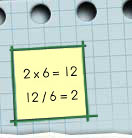
the relationship between multiplication and division.
Problems like: 10 x 2 = 20, 2 x 10 = 20, 20 / 10 = 2, 20 / 2
= 10
-
counting in steps in both ascending and descending order.
-
looking for patterns in tens and units numbers.
-
spelling and arranging the numbers 1-20 in order of size.
In addition to the above requirements the child also needs to have
a firm knowledge of the facts relating to odd and even numbers:
for example,
-
two ODD numbers add up to an EVEN number.
-
two EVEN numbers add up to an EVEN number.
-
an ODD number added to an EVEN number gives an ODD number.
-
when an ODD number is subtracted from an odd ODD number the
answer is an EVEN number.
-
when an EVEN number is subtracted from an EVEN number the answer
is an EVEN number.
-
when an ODD number is subtracted from an EVEN number, or vice
versa, the answer is an ODD number.
Vocabulary
The meaning of these words should be understood:
pattern, smallest, largest, true, untrue
|