|
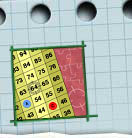
What is the number spiral?
The number spiral will introduce children to numbers and the ways
in which they work.
It provides a continuous sequence that clearly shows the relationships
between numbers.
Why not just use a number square?
Squares provide a good way of organising numbers but continuity
is lost between numbers ending in zero and those ending in one because
an artificial 'jump' has to be made to get from one to the next.
Number squares contain only 100 numbers and children often experience
difficulty crossing the 'hundred boundary' if their initial experiences
stop at 100. The spiral goes beyond 100 so does not build a mental
'brick wall'.
The limitations of number squares can best be seen when exploring
multiplication patterns. Compare, for example, the nine times table
on a number square with a spiral representation.
The spiral really 'comes into its own' when one begins to teach
calculations. Addition and subtraction can be clearly shown and,
because of the continuous nature of the number arrangement, there
is no need to pre-plan questions to avoid reaching the boundaries
of the display. To add, say, 36 to a number simply start at that
number, count up/down three squares (to add 30) and then move round
six and the answer is there.
Using the spiral to provide a representation of the number sequence
and as a tool for calculations will result in it eventually becoming
a 'mental image'. Children will develop an internal representation
of the spiral and will be better able to use what they know by heart
to figure out answers mentally through having a sense of where specific
numbers fit into the number system
|