Teacher notes
|
|
Introduction
Ladybird Families is intended to be used with Reception children,
though if you feel it is appropriate for other classes, then by
all means use it!
Within the Numeracy Framework teaching programme, the unit addresses
the following objectives (the numbers refer to the objectives described
in the Yearly Teaching Programme for Reception, in Section 3 of
the Numeracy Strategy document):
- Counting and recognising numbers:
Say and use the number names in order in familiar contexts such
as number rhymes, songs, stories, counting games and activities
(objective 2)
- Reading and writing numbers:
Recognise numerals (obj. 9); begin to record numbers (obj. 10)
- Solving problems:
Sort and match pictures (obj. 19)
- Exploring pattern, shape and space:
Talk about, recognise and create patterns (obj. 26)
Use everyday words to describe position, direction and movement
(obj. 27)
|
|
|
 |
|
|
|
How to use the activities in this unit
Ladybird Families song
The aims of the song are to develop childrens' understanding of
number through counting and comparing, and to sort and match objects
according to one criterion. The song asks children to:
- recognise the number of the ladybird
- compare this with other numbers presented in the picture
- match the numbers
- recognise mismatches
Activity 1
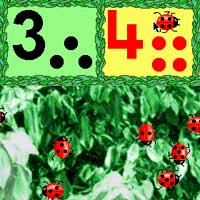
This follows on from the song by asking children to put the ladybirds
in the correct box using the mouse to click and drag.
|
|
 |
Activity 2
|
|
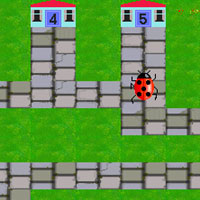
To successfully complete this game, children have to count the
number of spots on the ladybird, recognise the number of the correct
house, and use the mouse to click on the arrows to direct the ladybird
to that house. When all the ladybirds on the first diagram are home,
a new picture appears with a more complicated arrangement of paths
and houses. There are eight variations to try altogether.
|
|
 |
Worksheets
|
|
The worksheets are arranged in a developmental sequence to:
- match spots to given numbers
- write numbers
- read numbers and create that number of spots
- create the other half of a symmetrical pattern, count the total
number of spots, and write the total
- open ended extension activity to develop counting, writing and
symmetrical drawing skills
|
|
|
|
|
|
|