|
The sheets are designed to build both confidence and the ability
to recognise simple fractions through the use of partitioned rectangles
and other plain shapes. The immediacy of a pupil knowing whether
they are correct or not, together with simple prompts, builds confidence
and makes the task pleasurable. Through visual comparisons the idea
of equivalent fractions and simplest form are developed and used
as the pupil progresses through the sheets. Some of these sheets
have 'b' versions, which can be used as extra practice at the same
level or, where computers are crowded, alternate stations can use
different sheets to allow ownership of the work done.
Pupils can be put to work on a sheet with very little teacher guidance
or the need for interpretation from text based instructions. As
'Living Worksheets' they have proven to be an invaluable resource
in the classroom, offering high levels of motivation and success.
There is a direct path to a necessary skill without distractions,
and the outcomes do not need to be marked.
Concepts and skills acquired whilst using these sheets cover many
of the outcomes expected in the National Numeracy Strategy for Fractions
in years three, four, five and six.
Level three worksheets
Worksheets 1 & 1b
These first sheets use rectangles partitioned into squares or smaller
rectangles to introduce the concept of a fraction as one part out
of many of the same size and shape.
Worksheets 2, 3, 3b & 4
These develop the concept of recognising and simplifying simple
fractions through comparing squares and rectangles.
Worksheet 5
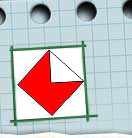
This uses some plain shapes, other than rectangles, to extend experience.
Worksheet 6
This is the last to be attempted in this folder. It uses a number
line approach. Distance has to be judged along a line, from left
to right, as a fraction of its length with the aid of an appropriate
scale.
Level four worksheets
Worksheets 7 & 7b
These continue to develop the recognition of fractions using plain
shapes that offer more of a challenge.
Worksheets 8 & 8b
These offer practice in simplifying fractions with visual reinforcement.
Worksheets 9 & 9b
These introduce equivalence, other than simplest form, with graphical
reinforcement at the start of each set.
Worksheets 10 & 11
These use the idea of fraction columns, rather akin to the use of
a measuring cylinder, judging the height of the liquid as a fraction
of the total height.
Worksheets 12 & 13
These continue with the use of fractional columns and incorporate
the empty space as the complement to the fraction filled. They both
offer further practice with simplification of fractions in a visual
manner.
Worksheet 14
This is the last to be attempted in this folder. It uses a number
line approach. Distance has to be judged along a line, from left
to right, as a fraction of its length with the aid of an appropriate
scale. Some answers need to be written in their simplest form.
Level five worksheets
Worksheets 15 & 15b
These continue with equivalence, other than simplest form, with
graphical reinforcement at the start of each set.
Worksheets 16 & 16b
These introduce the concept of dividing numerator and denominator
by a common factor to simplify a fraction.
Worksheets 17 & 17b NB! IKKE OVERSATT, FJERNET
These introduce improper fractions that simplify to whole numbers,
followed by multiplication of a whole number and simplification.
Worksheets 18 & 18b
These use large squares and rectangles, subdivided into coloured
sections of squares, that will all simplify when expressed as fractions.
The worksheets are based upon Living Worksheets produced
by John Ellis.
|